


Testimonials
Price |
460,00€
Set in 4 times free of charge with 
Duration |
Participants |
Max.
Author |
Manufacturer |
100% online training.
Next training session: November 6, 2026
Funding opportunities available for professionals in the equestrian world.
Managing the well-being of your horse requires understanding its nature and how it functions, in order to respect its basic needs.
Who is this training for?
This training, based on the latest scientific research and the expertise of recognized professionals, is intended for amateurs and professionals.
This training program develops the very concept of equine welfare , enabling you to optimize your daily equine care practices . It informs you about regulations and your obligations. It deepens your knowledge of equine nutrition, locomotion, and biomechanics to optimize the horse's physical well-being. It also covers learning methods to improve training and behavior.
The knowledge acquired is assessed based on an online questionnaire. Successful completion allows you to obtain, individually, the La Cense Horse Welfare Certificate.
The training takes place remotely and lasts 3 months :
Weeks 1 and 2: Detention – by Deborah Bardou, Ethologist and President of the Animal Welfare Commission of the FFE.
Weeks 3 and 4: Nutrition – by Angélique Descarpentry, Agricultural Engineer specializing in equine nutrition
Weeks 5 and 6: Well-being and locomotion – by Anne d'Hautefeuille, Animal Osteopath and BFE EE2 Instructor
Weeks 7 and 8: Education – by Nathalie Accurso, Wellness Coordinator at Haras de la Cense, BPJEPS Instructor, BFE EE 2
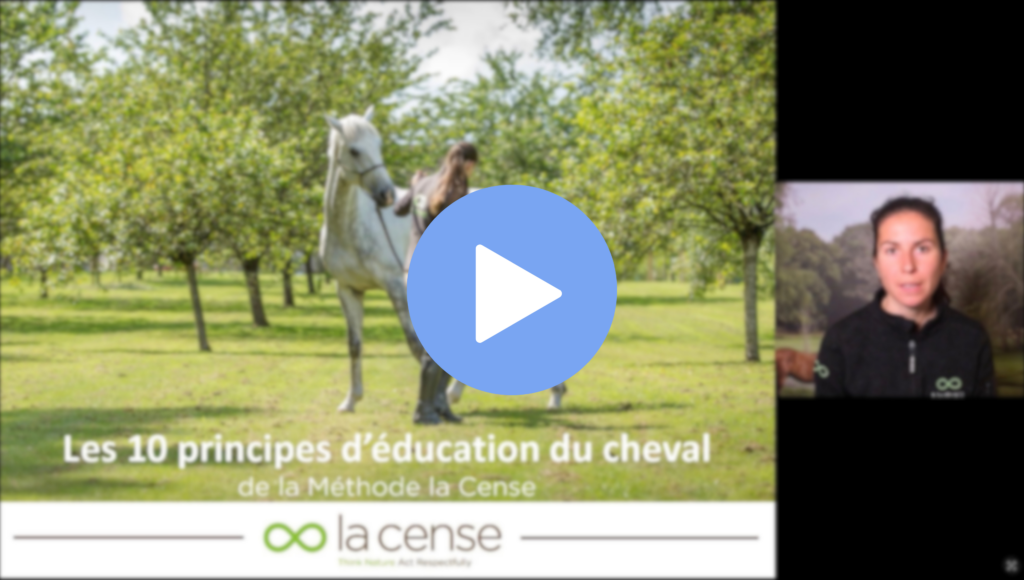
Weeks 9 and 10: The 10 Principles of Horse Training – by Nathalie Accurso, Welfare Officer at Haras de la Cense, BPJEPS Instructor, BFE EE 2
Weeks 11 and 12: Evaluation questionnaire
At the end of the training, you will take a 25-question quiz covering all the topics. To obtain the certificate, you must achieve a minimum score of 60%. You have two attempts.
The training program is open. on a dedicated e-learning platform and its mobile application, from November 6, 2026 to February 6, 2027.
👉 How can I finance my training?
You can follow it at your own pace. as the modules are made available:
– Module 1: November 6, 2026
– Model 2: November 20, 2026
– Module 3: December 4, 2026,…
The modules are accessible until February 6, 2027.
The back-to-school webinar is scheduled for a specific time (weekday evening at 19pm). If you are unavailable, you will have access to the replay.
Practice quizzes are available to test one's knowledge.
This training requires between 30 minutes and 2 hours of time per week. It is easy to follow alongside a professional activity.
Set in 4 times free of charge with


By purchasing from our site, you are contributing to the funding of innovative and responsible solutions through our Endowment Fund, which, through understanding animals, helps to reconnect humankind with Nature. Learn more
Secure payment
Professional supervisors
Certifications at stake
Any questions?
formations@lacense.com
Select your status to access the associated financing conditions:
VIVEA can cover up to €300 of your training costs.
To find out if you are funded by VIVEA:
Steps to register with VIVEA funding:
Apply to FIF PL to have your training fully funded .
To find out if you are funded by the FIF PL:
Steps to register with FIF PL funding:
Contact AGEFICE to submit your funding application.
To find out if you are AGEFICE funded:
Steps to register with AGEFICE funding:
France Travail can finance your training with an AIF.
To find out if you are funded by France Travail:
Steps to register with France Travail funding:
Agricultural sector employee: Talk to your employer to find out if you can apply to OCAPIAT for funding.
To find out if you are funded by OCAPIAT:
Steps to register with OCAPIAT funding:
Employees outside the agricultural sector: Discuss with your employer the OPCO (Skills Operator) affiliated with your company. Then contact this OPCO to find out about their funding options.
Receive a free video excerpt of the training
It's sent! Check your email inbox, your video clip will arrive in a few moments.

